Who are we
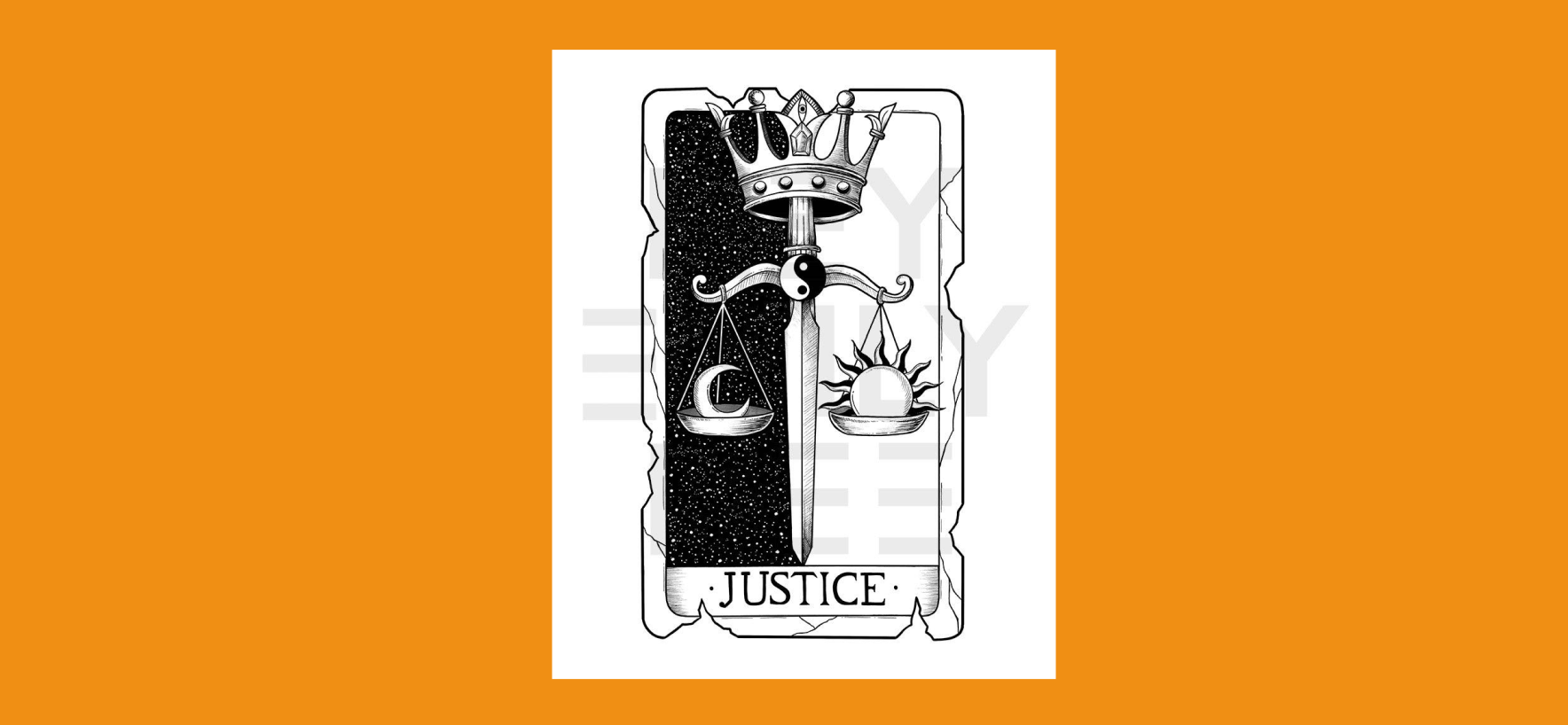
TrueSight DAO envisions a world where humanity is reconnected with its inherent divinity, embraces love for all beings, and lives in harmony with nature. We believe this vision will be realized by restoring social and environmental justice through open-source principles, transparency, and accountability.
We bring our vision to life by driving positive change through profitable social ventures that promote social and environmental justice, alleviating suffering. By building and contributing to these ventures, we earn governance tokens that increase in value as our impact grows. This increasing value allows us to create a meaningful impact on the world while supporting the self-actualization of our members.
Our core values are Mindfulness, Compassion and Equanimity.
We use the term DAO (Decentralized Autonomous Organization) to mean an internet-based community combining transparent governance, individual autonomy, and recorded commitments to shared work and capital. Members hold governance tokens (TDG) tied to contributions and risk; those tokens carry voting rights on DAO fiat allocation and policy matters as spelled out in this handbook. The next section states plainly how that pattern relates to cooperatives and to Web3 DAO stereotypes — including where we deliberately diverge.
North star
Our purpose is to heal the world with love. Our concrete mission is to restore 10,000 hectares of Amazon rainforest. Every DAO decision — what to ship, whom to partner with, how to price TDG cash-out, what to build next — should trace back to whether it moves us toward that hectare target in service of healing. Current growth goals for 2026: $40,000 in QR-code-tracked sales and 100 USA Agroverse partner venues by year-end (live progress: advisory snapshot).
System at a glance
The DAO runs on four connected surfaces.
An audit-trail mirror copies Main Ledger rows into our private TrueChain blockchain for tamper-evidence, with a Google Apps Script block explorer. The public Beer Hall feed publishes a daily digest of what shipped, and the oracle can surface any of this via natural-language questions.
Sweat equity, cooperatives, and the DAO label
Public language about DAOs often implies token speculation, constant drama, and governance as performance. TrueSight borrows some interfaces familiar from Web3 (proposals, voting, transparency norms) while anchoring economics in sweat equity, operating businesses, and a ledger-first record of contributions. Many members experience TrueSight as closer to a cooperative profit-sharing pattern with digital governance rails than to either a classic consumer cooperative or a purely on-chain protocol community.
This is descriptive language about how we operate in practice; it is not legal classification as a cooperative corporation in any specific jurisdiction.
Compared to many traditional cooperatives, TrueSight is similar in spirit when surplus is tied to member effort and shared ventures, when receipts matter, and when democratic input exists on rules and allocation. It differs in the specifics: global, distributed participation; a hybrid stack of WhatsApp, sheets, DApp flows, and governors rather than only annual in-person member meetings; and a governance-token design that is explicitly ledger-accounted rather than only “hours plus patronage refunds” paperwork (though the rubric is our parallel discipline).
Compared to many “traditional Web3 DAOs”, TrueSight is similar in using public conversation, proposals, and token-weighted processes for some treasury and policy decisions. It differs where hype cycles dominate: TDG is not treated primarily as a casino chip on an open bonding curve; the canonical accounting is the ledger; buy-back and withdrawal patterns are documented under Treasury; and much of the compounding work is intentionally boring (logistics, compliance, finance) rather than social-layer engagement farming.
For longer member-facing narratives on execution versus governance theatre, see the blog notes on sweat equity and what our “DAO” is building and on cooperative profit sharing versus co-ops and Web3 DAOs.
The problem
In our modern era, shaped by the industrial age legacy, winner-takes-all networked business models, notably in the web 2.0 era, have widened economic disparities and undermined inclusiveness, leading to significant cultural and biodiversity damage.
Moreover, our relentless pursuit of profit and productivity, inherited from the industrial age, has driven a growing disconnect between humanity and its spirituality, fellow human beings, and the natural environment. This disconnect has deepened with advancements in technologies like artificial intelligence and robotics.
As a result, many lower-income individuals contribute to these models, often sacrificing their well-being. Despite promises of career advancement, employees face longer working hours and dwindling community bonds as profit motives override social cohesion.
Additionally, powerful businesses exert significant financial influence on liberal democratic governments, reinforcing their dominance and perpetuating income inequality. Unchecked, this trend risks ushering in a modern form of feudalism, where the few control the majority.
Furthermore, the linear thinking ingrained in these models has accelerated climate change, worsening environmental degradation and threatening global ecosystems. This shortsightedness hampers individuals' self-actualization and jeopardizes the natural world's well-being.
In this concerning scenario, individuals risk becoming mere cogs in the corporate machine, devoid of soul, while the planet suffers the consequences of our disconnect and disregard.
The proposed solution - a metagame
Overview
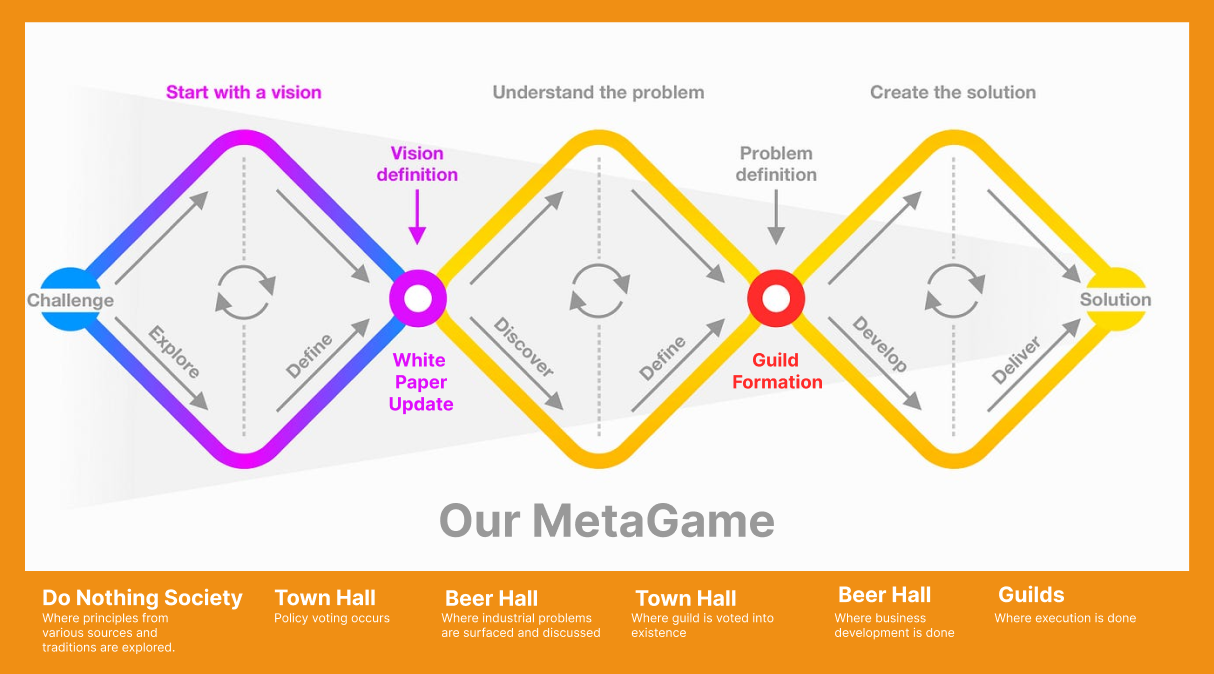
Our Metagame is a collaborative social experiment to explore new ways of creating impactful, socially conscious businesses. By engaging participants in an interactive and dynamic process, we aim to develop innovative solutions for a more just and sustainable world.
In this metagame, participants work together to validate three important hypotheses. We believe through the process of validating these hypotheses, we will progress towards realizing our vision for the world:
Our hypothesis
1. Open-source principles have the potential to extend far beyond the tech realm, fostering impactful businesses capable of disrupting unjust practices.
2. Open accounting and our shared ledger empower precise recording and equitable distribution of economic value, rewarding contributors according to their inputs.
3. Individuals with a clear vision of their fully realized selves are more likely to take action when presented with a path towards their truest potential.
Engaging in our metagame will earn participants governance tokens according to the rubric. The headline rates are: provided funds — 1 TDG per 1 USD of liquidity injected; provided labor — 100 TDG per hour of human effort; and USDT transactions — −1 TDG per 1 USDT sent and +1 TDG per 1 USDT received (see the table under Rubric).
Governance tokens (TDG) are not minted on a public blockchain today. Instead, TDG is recorded on our Google Sheet ledger. Around each solstice and equinox, governors review contributions that have been scored by Edgar through the DApp, approve them, and transfer consolidated line items into the main ledger. This seasonal rhythm symbolizes the harmony between our initiative's growth and the natural world's rhythms, while keeping human oversight on top of automated scoring.
Actions members can take
In this section we describe in detail the types of action a member can take within the scope of our MetaGame.
Profits generated from our profitable business will be used to back the value of governance tokens that have been issued out in exchange for participants contributions.
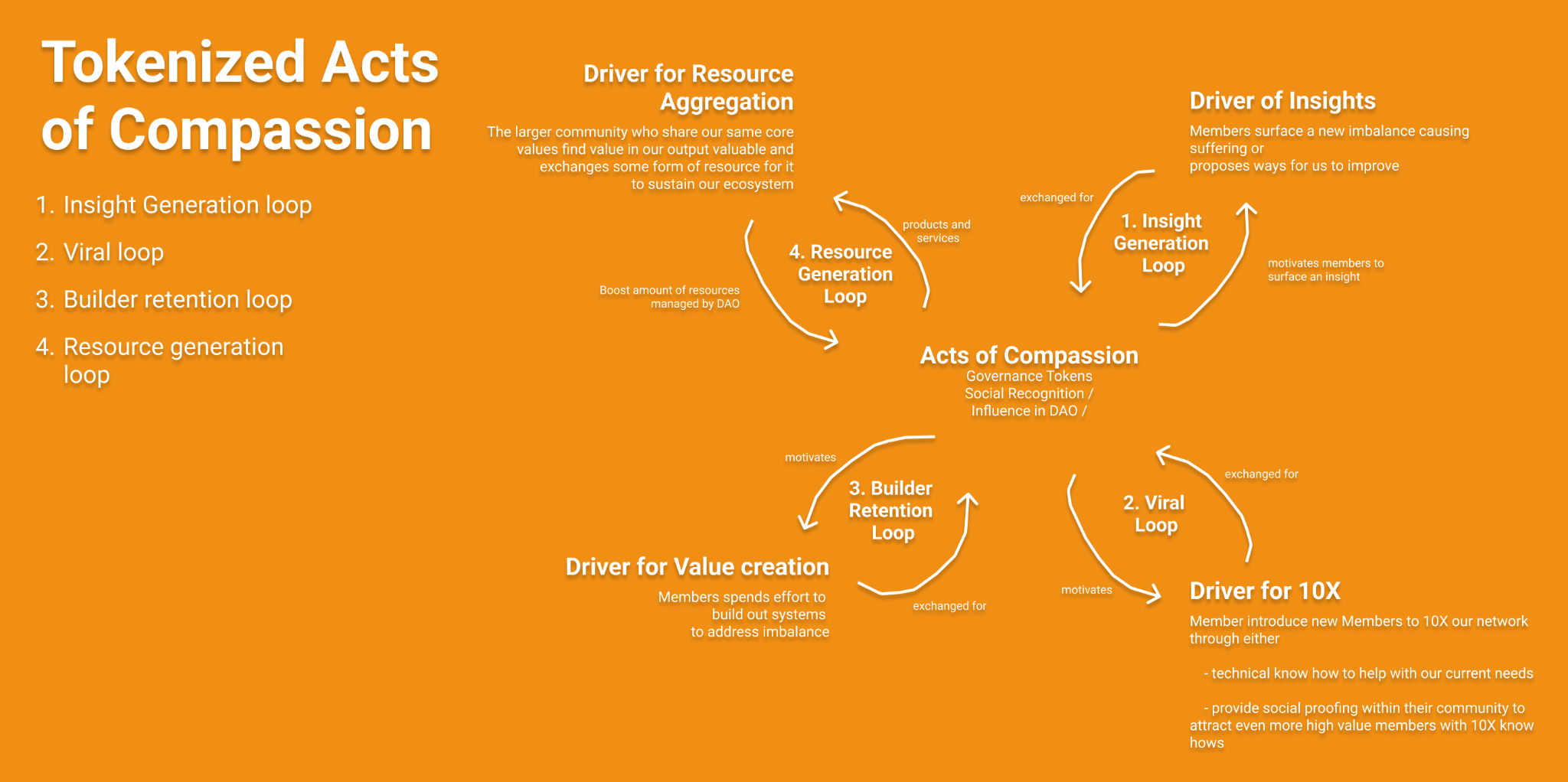
Part 1: Generating insights to give us direction
To create a better world based on compassion, we'll start by seeking insights. We gather these by sharing observations of systemic causes of suffering whenever we encounter them — in the Beer Hall, on the blog, or wherever a member chooses to surface them.
Part 2: Inviting more values-aligned members who can help build our DAO
Whatever the challenges we are facing right now in our DAO to get to the next level, we believe somewhere out there is an expert that is able and willing to lead us tackling the challenge in exchange for governance tokens in our DAO. To do so we invite new members into conversations — often one-to-one first, and into the Beer Hall when the topic calls for broader input.
Part 3: Improving our Gaming OS
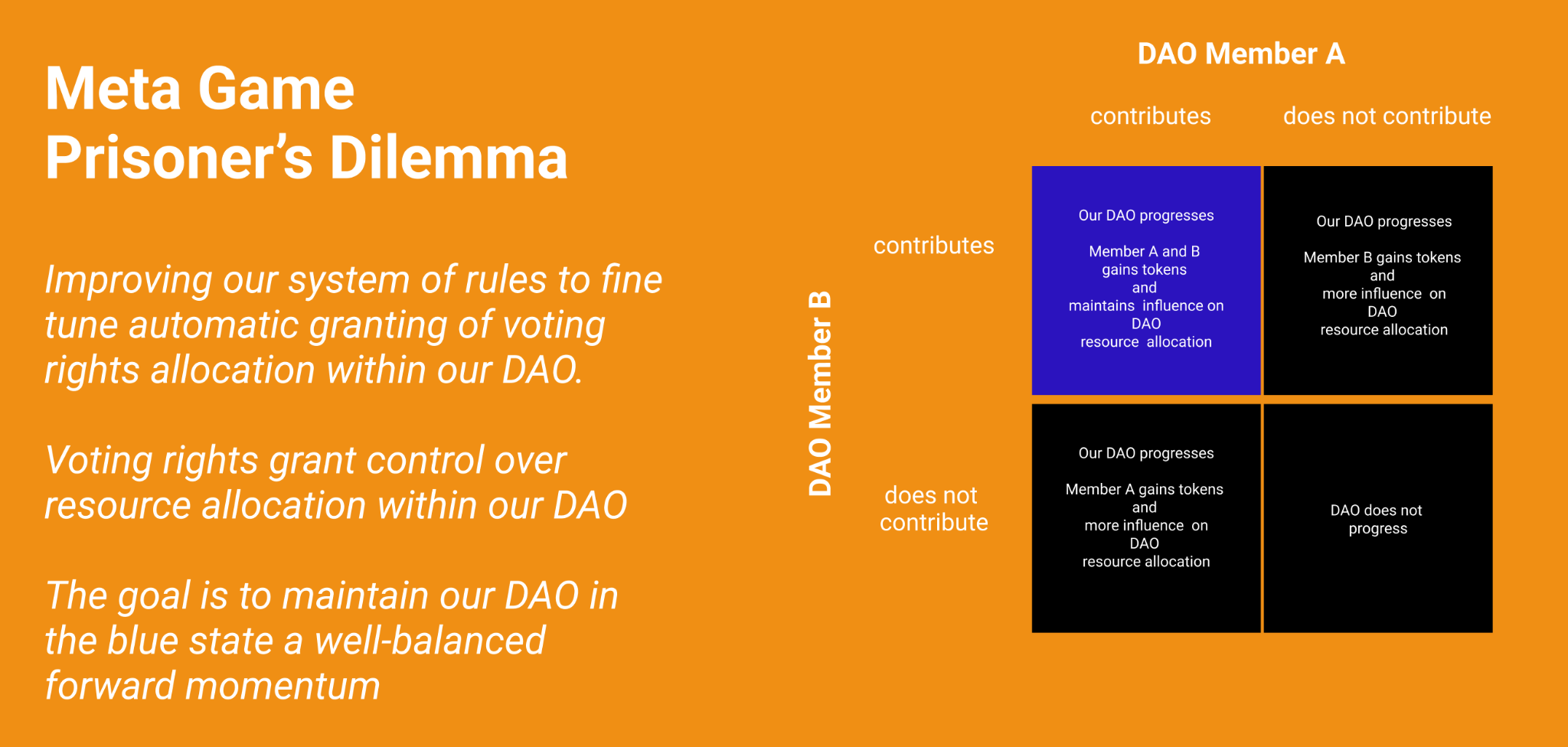
In part three of our metagame, participants are invited to improve upon the way our DAO operates. At its core the DAO is a simple way to record voluntary contributions against our mission, so most improvements are about making that recording sharper, faster, or more legible. Improvements are proposed and implemented through the following operational aspects:
Operate:
Part 4: Contribute in Guilds
This section explains how members can actively engage within our DAO by contributing to guilds. Participants are encouraged to rethink conventional business models, leading to improvements of our initiatives. Each initiative involve a guild consisting of members actively contributing to it and other non-guild members periodically doing so of their own free will.
Communication for these initiatives is tightly scoped; operational coordination for Agroverse runs through a small set of WhatsApp channels for executors (see Chatrooms). Notably, profits generated will be reinvested in our DAO, boosting governance token value. This section underscores our DAO's interactive and entrepreneurial nature, with members actively driving innovation.
Guilds and Initiatives - Operational Framework
Guilds and initiatives are the core of our meta game and operate autonomously, with participants contributing voluntarily. This section describes how they operate.
Initiative Contribution Areas
Participants can contribute to existing initiatives through:
In real life activities
Online Content Creation and Marketing
Compliance and Regulation
Community Building
Code Development and Automation
Contribution Principles
Decentralized Governance
Existing initiatives are managed through:
Self-Organizing Guilds
Participants join existing guilds to contribute to initiatives, with:
Embracing Emergence
Our trustless network encourages:
Guild life cycle
This section describes phases that historically applied when guilds moved from [test] through [initiative] to [ongoing]. When it was written, we assumed we might keep adding scope and spinning up new guilds over time.
Today, DAO scope is fairly fixed: Agroverse and related work run with a tight executor model (see Chatrooms). We are unlikely to broaden into many parallel guilds unless DAO members vote otherwise. In practice, community activity is also quieter than in earlier years, so we are not counting on a wave of new guild formation—while still leaving room for a future vote to expand if energy returns.
The phases below remain a useful reference for how a guild can move from design through launch to steady operation, even if we only operate a small number of guilds in practice.
Phase 1: Rethink - <guild>[test]
During this phase, designated chat rooms will be labeled with the [test] tag
Participants will examine existing value chains from end to end and rethink how these value chains could be redesigned and contributions along the value chain tokenized. Part of the goal is to iron out any information arbitrage which leads to accruing of unfair economic gains to existing participants within these value chains. These information arbitrage are the source of monopolies that lead to the unfair accruing of economic gains.
The outcome of this phase is a business model canvas and an accompanying whitepaper that fully describes the new business model that can be executed without any ambiguities.
Roles
Phase 2: Implement - <guild>[initiative]
During this phase, designated chat rooms will be labeled with the [initiative] tag. The guild master is responsible for creating a new JIRA initiative to track tasks within the initiative's scope. Completed tasks should be clearly marked as requiring tokenization attention, while tasks that have been tokenized should be explicitly indicated as such.
Guild membership will be limited to 8 members. When the guild reaches its capacity, the introduction of a new member with significant potential for self-actualization will result in the departure of an existing member with the least capacity for self-actualization.
In this phase, participants will turn the business model details into a real-world, functioning business that generates profits in alignment with the DAO's purpose and values.
Additional roles will be defined based on the outcomes of the rethink phase, and grants of fiat capital and governance tokens required for this phase will be presented for approval by the parent DAO.
Phase 3: Operate - <guild>[ongoing]
During this phase, designated chat rooms will be relabeled with the [ongoing] tag.
In this phase, the necessary steps to continue operating the business will be well-defined and tokenized. Participants who execute these steps will be awarded governance tokens to incentivize continued success. Profits generated from the business will be channeled back to the parent DAO's vault as outlined within our governance policy.
No additional roles will be defined as the business is considered to be in a stable state of generating profits.
Deprecation
Governors have the authority to propose the deprecation of inactive guild/initiative chat rooms within our DAO through the governance channel. If a majority vote is obtained, all existing members will be removed from the chatroom, and the chatroom will be shut down.
Collaboration guidelines in labeled chat rooms
Outcome oriented discussions
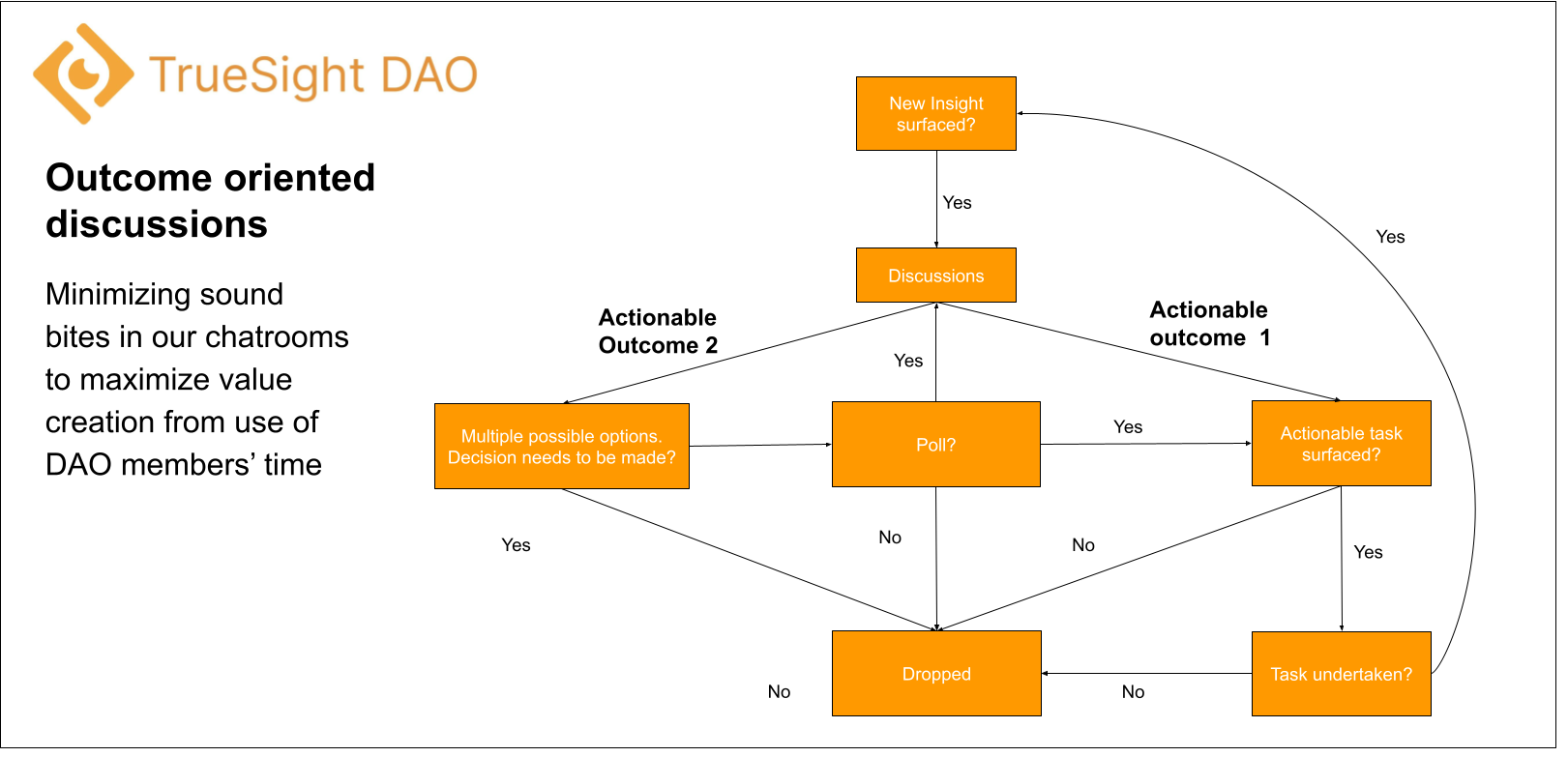
Participants are strongly encouraged to be outcome oriented in their communications within these chatrooms. Every single piece of communication should strive towards defining what is the next actionable step within the scope of which the chatroom is applicable for.
Participants are discouraged from chatter that is irrelevant which distracts other members attention and focus from the desired outcome of the initiative.
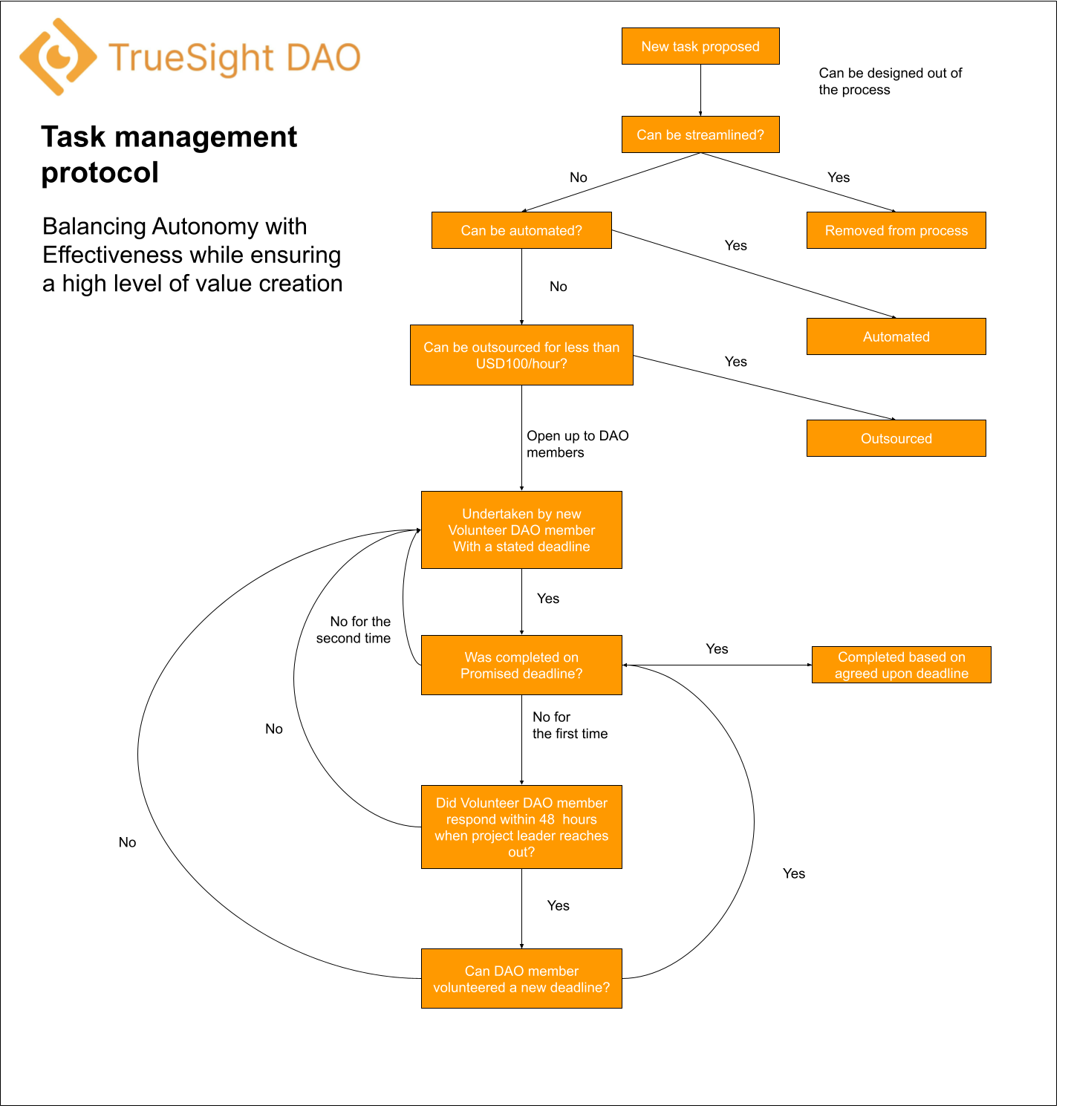
Task Management Protocol
Our network's task management protocol is built on autonomy and decentralization. Members voluntarily contribute to existing initiatives, defining their own tasks that align with their interests and expertise within fixed initiative scopes.
Contribution Process
Members contribute independently, making decisions without central governance. This approach reduces the need for tight-knit collaboration and minimizes duplication. To facilitate openness and progress, members report their completed tasks and contributions.
Self Reporting
This open reporting enables other members to:
• Build upon existing work
• Identify areas for further development
• Leverage completed tasks to inform their own contributions
Decision-Making at Execution Forks
In our network, when members encounter a fork in the execution path with multiple alternate routes, they have the flexibility to make independent decisions. Alternatively, they can share their proposed direction and invite feedback from others, fostering a collaborative environment.
This approach embodies our trustless network principles, empowering members with autonomy and decentralizing decision-making. By removing centralized governance, we encourage adaptability, resilience, and community-driven progress.
Members are free to choose their path, and execution continues uninterrupted until the next decision point arises. This open, flexible framework promotes innovation, creativity, and collective growth.
Tokenomics
Scoring follows the rubric: provided labor earns 100 TDG per hour of human effort; provided funds earn 1 TDG per 1 USD of liquidity injected; USDT movements score at −1 TDG per 1 USDT sent and +1 TDG per 1 USDT received. The rubric has been stable for a long time; future changes are more likely to adjust these rates via vote than to add many new line items.
Contribution claims are based on self-evaluation and peer reviews. Members submit TDG contribution claims through the TrueSight DApp (for example report contribution); we no longer scan WhatsApp for TDG scoring. Telegram is still used operationally — sales QR scans, batch QR generation signoff, notarizations, tree-planting records, and shipment movement are parsed from our Telegram chat logs by Apps Script processors under tokenomics/google_app_scripts/ — but those flows feed inventory and sales, not TDG awards. The general DApp entry point is truesight.me/dapp.
Claims are scored by Edgar and reviewed by governors. Approved amounts are written to our ledger, which provides the canonical track record of contributions and TDG balances. Around solstices and equinoxes, governors batch-approve scored items and move consolidated rows into the main ledger as needed.
TDG exists as ledger entries, not as tokens in a member-controlled on-chain wallet. Member identities and payout preferences may still be registered with our DAO for operational and reconciliation purposes.
Dispute resolution
In the event that a dispute arises between the contributor who performs the contribution and the AI who does the validation and scoring of the contribution, the contributor has the right to surface the dispute to the Townhall for discussion and voting by our General Assembly members.
As resolution, relevant entries in the rubric and ledger will thereafter be updated.
Treasury
TDG is accounted for on our ledger (see Tokenomics). Following DAO votes that moved away from Raydium-style liquidity pools and routine DEX-based open-market operations for TDG, buy-back and member cash-out are handled through a USD buy-back reserve on the ledger and the withdraw voting rights flow in the DApp, rather than requiring members to use Phantom, Solana, or on-chain DEX swaps for TDG.
Ledger-based buy-back and withdrawals
The DAO may allocate budget to a buy-back reserve recorded on the ledger and debit that reserve when members cash out voting rights through the DApp, consistent with the merged proposal to migrate away from Raydium toward a ledger-based buy-back program. Limits, pricing, and timing follow the current rubric, vault policy, and any later proposals.
AGL shipment financing fee
For future Agroverse Guild Ledger (AGL) contracts that are shipment financing (direct shipment with physical collateral), the voted default fund management fee is 20%, unless a specific contract states otherwise. Operational funds ledgers that invest in other AGLs do not charge an additional fee at that layer, to avoid double-charging. Existing contracts stay on their prior terms unless amended by mutual agreement.
In the event that a member chooses to exit their position prematurely, the equity position in the managed ledger they invested in will be reclaimed from them at a significantly discounted value compared to their initial contribution. This serves as a penalty for early exits. (The penalty applies to that managed-ledger equity position, not to governance tokens earned for contributions.)
Nomenclature
This section highlights the essential components of our DAO that members will encounter as they navigate through the flow of our core process based on the Double Diamond Design Thinking methodology. These elements are instrumental in facilitating a smooth and structured execution of our initiatives.
Carnival of Truth
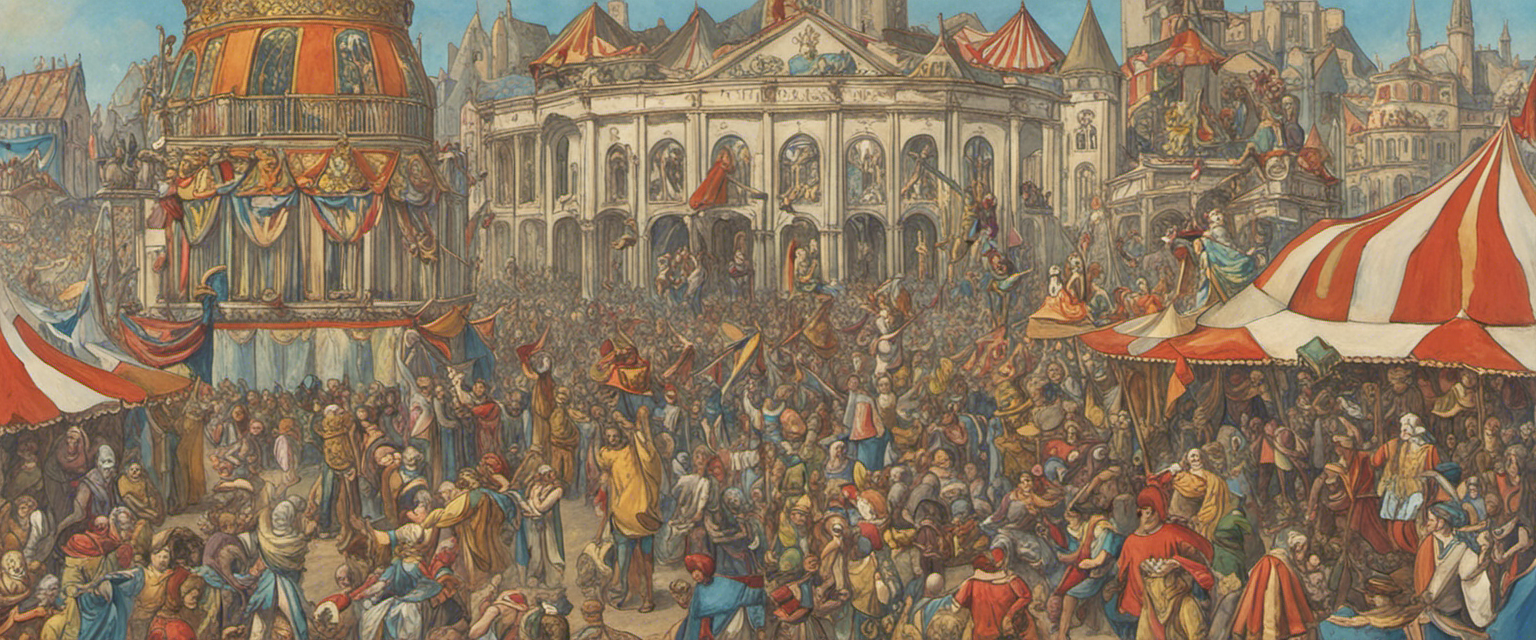
Step into a realm of knowledge, curiosity, and vibrant exchange! The Carnival of Truth is where our dedicated Truth Seekers, the heartbeat of TrueSight DAO, come together periodically in a spirit of celebration and exploration.
Imagine a gathering reminiscent of the epic Neverwinter's Night series, where festivities are as rich as the discussions. Here, DAO members unite at a chosen location of collective decision to share, learn, and delve into the intricate tapestry of TrueSight DAO's initiatives.
This vibrant carnival is not just an event; it's a mosaic of minds, a symphony of ideas, and a vibrant hub where every member plays a role in shaping our shared vision. It's a space to exchange insights, discuss initiative contributions, and ignite the flames of innovation.
So, when you hear whispers of the Carnival of Truth, envision a lively and engaging carnival where the pursuit of truth and knowledge takes center stage. Join in, participate, and let the festivities enrich your journey with TrueSight DAO.
Communications
Different kinds of signal travel on different rails. The point is fit-for-purpose reach, not broadcast volume. Earlier versions of this handbook described many labeled WhatsApp channels and a daily digest pushed into the Beer Hall; in practice those produced high authoring cost and low read-through, so we consolidated.
Framework and reflective writing — blog
Long-form pieces on structure, economics, coordination, and philosophy (sweat equity, cooperative profit sharing, warehousing economics, DAO evolution post-LLM) live on the blog. This is where a reader orients before engaging.
Operational updates — landing page
Inventory, shipments, milestones, logistics, and sales movement are auto-compiled daily at 00:00 UTC on the landing page. Two GitHub Actions close this loop: advisory-snapshot-refresh.yml runs every six hours to regenerate ADVISORY_SNAPSHOT.md across the 12 curated DAO repos and publish it to the agentic_ai_context and ecosystem_change_logs repositories; beer-hall-digest-daily.yml runs at 00:00 UTC to draft and auto-merge the daily Beer Hall archive (drafted by Claude Sonnet 4.6 using the two most recent archives as few-shot style examples). Operators on iOS can push live tactical intent into the same advisory context via the Shortcut → edgar.truesight.me/oracle/reminders_sync pipeline; each POST is archived to ecosystem_change_logs/reminders_raws/ so the Oracle always has fresh context.
Oracle — natural-language DAO advisor
The Oracle is a Grok-backed chatbot that reads the live advisory base, the daily snapshot, open Reminders, and the strategic blocks — then draws a hexagram and answers member questions grounded in current DAO state. It is the ask-a-question layer over the ledger, change-log, and Beer Hall feed, so members can orient without skimming raw feeds.
Beer Hall — community digest, archive-only
The Beer Hall is our community digest, not a realtime channel. A daily GitHub Action at 00:00 UTC drafts a two-message update via Claude (Message 1 = TLDR; Message 2 = Shipped links + community signals from the Telegram log), commits it to the static feed at ecosystem_change_logs/beer_hall/feed/, and refreshes the advisory snapshot that feeds the Oracle. As of 2026-04-19 the digest is archive-only — it is no longer broadcast to WhatsApp. The previous WhatsApp firehose was flagged as too noisy by the community (Kirsten, Fatima, Garis); Fatima proposed a newsletter shape and that is what the static feed + Oracle Q&A pattern now provides. Day-to-day ops chatter still happens in the small executor WhatsApp rooms below.
Agroverse executor channels
Day-to-day execution runs through two WhatsApp spaces for executors on the critical path:
Much of the market insight and community-driven inbound sales traffic reaches core leadership directly rather than through a public WhatsApp room, so those flows should not be expected to appear in the executor channels above.
Direct messages
Relationship, sensitive material, and small-circle decisions move over direct message to the core contributors involved. Not everything is broadcast; not everything should be.
The Do Nothing Society
The Do Nothing Society is where we explore the longer-horizon question of how humans interface with the DAO once AI automation handles the bulk of internal processes — future-facing discussion, not day-to-day ops.
TDG balances and ledger
TrueSight DAO governance tokens (TDG) are recorded on our Google Sheet ledger. We retired the former Solana mint; there is no active on-chain TDG balance to hold in a self-custody wallet. Members do not need a Phantom wallet or any chain address for TDG accounting today.
The DAO may still use custodial wallets for treasury assets (for example USDT or Bitcoin) where relevant; that is separate from TDG ledger entries.
Governance Tokens
Our governance tokens (TDG) are accounting units issued and tracked on our ledger within our community. Ownership of governance tokens as recorded on the ledger allows you the following types of benefits:
Governors
Governors of our DAO are caretakers of our community. A formula on the Governors tab of the Main Ledger ranks every contributor by total TDG issued over the trailing 180 days (excluding passive USDT-flow lines: “1TDG For every 1USDT received” and “-1TDG For every 1USDT sent”) and seats the top 10. The window slides daily, so the roster is technically continuous; equinoxes and solstices are the formal acknowledgment cadence, not the rotation event. That tab is the source of truth for editing rights on ledger, rubric, community-channel (WhatsApp and Telegram) administration, and the DApp permission system. No campaigning, no self-nomination — the only path in is sustained contribution.
Privileges
permissions.json via governor_permissions.html
Duties
Time of elections
Guild
A guild is a decentralized group of members with expertise in a specific area that contribute to a specific DAO initiative. Each initiative can have multiple guilds. The guild operates autonomously and makes its own decisions regarding how best to contribute their skills and resources to achieving a specific aspect of a initiative's goals.
Participation is incentivized through awards of governance tokens (TDG) recorded on our ledger. By creating guilds, our DAO can tap into the expertise of its community more efficiently and effectively to achieve its objectives.
Today we run with tight scope: we do not expect to spin up many new guilds or parallel chat-room taxonomies. Operational dialogue for Agroverse is concentrated in the executor WhatsApp channels described under Chatrooms.
Ledger
This is a Google sheet which keeps track of all contributions ever made by DAO members within our ecosystem as well as the amount of governance tokens awarded in exchange for that contribution. Submissions arrive through the DApp; Edgar scores them, and governors approve and consolidate rows into this ledger on a seasonal schedule.
Rubric
The rubric is a Google sheet that defines how TDG are awarded by category. It has been very stable and has not changed in a long time.
If we adjust scoring in the future, we expect it will more likely be through a proposal to change the exchange rates for the two primary rows (provided funds and provided labor) rather than continually introducing new categories and lines.
| Category of contributions | Type of contribution | TDG tokens awarded |
|---|---|---|
| Provided funds | For every 1 USD of liquidity injected | 1 |
| Provided labor | For every 1 hour of human effort | 100 |
| Transactions | For every 1 USDT sent | −1 |
| Transactions | For every 1 USDT received | 1 |
Governors may still propose updates when needed; the sheet remains the source of truth for any wording beyond this handbook snapshot.
Amendments
This section will be periodically extended based on voting outcomes within our channels. A screenshot of the voting outcome will be attached along with the addendum that will be applied
20230417 - Confidential and Proprietary Data Policy
Voted in Townhall - past into effect 17th April 2023

Prior to accessing dedicated chat rooms where our guilds operate, members are required to sign and submit a copy of our non-disclosure agreement (NDA) and/or a non-compete agreement. As according to the terms defined within our non-disclosure agreement (NDA), members who have contributed private and confidential data they own will retain the right to use them.
If a guild member wishes to commercialize proprietary data outside of the scope of the DAO, they will be required to enter into a licensing agreement based on the defined licensing terms therein.
If a guild is translating its business model into a real-world implementation, members will be required to sign a non-compete agreement specific to the guild's scope.
TrueTech Inc, a Delaware corporation, is the technology solutions provider for TrueSight DAO. In the event, a member breaches the NDA, licensing agreement, or non-compete agreement prior to the incorporation of a initiative as its own independent legal entity, TrueTech Inc will seek legal remedy on behalf of the Guild under Delaware jurisdiction.
20230430 - Content Policy
Voted in Beer Hall - past into effect 30th April 2023

New policy is now in effect across all our chatrooms.
Sexually inundated content will no longer be tolerated hence forth.
Violators will be given a verbal warning and their post removed for the first two violations. They will be permanently banned upon their third violation
20230430 - Non-Aligned Transaction Policy
Voted in Town Hall - past into effect 30th April 2023

Future transactions passing through our network that are not aligned with our DAO purpose and mission will henceforth be charged with a gas fee. A follow up poll in our town hall on gas fee to be charged will be conducted.
Superseded note (2026): this "gas fee" framing is retired. With the Solana mint closed and TDG accounted for on the ledger, the DAO's two actual revenue mechanics are (1) an operating slice of \$2 baked into each retail SKU (see Agroverse unit economics) and (2) a 20% management fee on post-recoup profit from shipment-financing (syndicate) AGLs. Neither is per-transaction, and neither behaves like a blockchain gas fee.
20230502 - New Member Onboarding Policy
Voted in Town Hall - past into effect 2nd May 2023

Prior to being allowed entry into a guild, requesting members will be required to go through an onboarding process where we determine the role the member will participate as.
As part of the onboarding process, new members will be required to read our DAO’s white paper to understand how we operate. This will reduce any confusion new members may have when being introduced into our ecosystem to interact with other participants in the space.
20230508 - Non-Compete Policy
Voted in Agroverse Guild - past into effect 8th May 2023

To ensure we become economically self-sustaining, we will need to ensure there are no unauthorized misuse by members with access to proprietary knowledge released by other members within the guild.
Utilization of the knowledge to set up a competing entity will compromise our goal of becoming economically self-sustaining.
New members seeking to join EcoVerse21 guild will need to sign a non-compete agreement specifically pertaining to the scope of the EcoVerse21.
https://TrueSight.me/dao/agroverse/noncompete
20230525 - Guild Size Limit Policy
Voted in Townhall - past into effect 25th May 2023

With reference to the Amazon 2 pizza rule, its been observed there is an optimal guild size beyond which productivity within the guild starts waning. To ensure optimal operation of guilds, guild membership size will be restricted to 8 members henceforth.
In the event a new member is to join a guild and guild is at capacity, an existing member will be chosen to be booted from the guild based on the following order
20230603 - Town Hall restrictions policy
Effective 3rd June 2023
Non-token holders will no longer be allowed in our town hall where members of our general assembly congregate
General community members and the general public can continue to stay about general policy updates as well as initiative progress in our Beer hall and our community website after voting have pass in our town hall
20230628 - Fiat Injection policy
Voted in Townhall - past into effect 28th June 2023

TrueTech Inc will be utilized as holding bay for fiat capital injected by members to finance expenses that might be incurred during the course of our guild executing on our community initiatives
This route ensures external fiat capital injection does not throw off the balance of our DAO’s contribution/token based governance system
20230703 - Governors chatroom proposal limits
Voted in Townhall - past into effect 3rd July 2023

Governors have the right to propose unlimited number of chatrooms in our DAO.
20230709 - Task management protocol adoption
Voted in Townhall - past into effect 9th July 2023

DAO has voted to adopt task management protocol
20230709 - Historical: Ethereum migration vote
Voted in Townhall - past into effect 9th July 2023

Historically, DAO members voted that once we had successfully sold off our first shipment of 100KG Agroverse cacao nibs, we would begin migrating governance tokens to the Ethereum chain. In practice, the DAO has chosen not to pursue that on-chain migration for TDG at this time: we retired the Solana mint and use the Google Sheet ledger as the canonical record of TDG. This section is retained for transparency; current practice is described under TDG balances and ledger and Tokenomics.
20230919 - Total number of channels limit
Voted in Townhall - past into effect 19th Sep 2023

Henceforth total number of channels within our WhatsApp community will be limited to 8 (excluding our announcement channel)
When WhatsApp community is at capacity, if DAO seeks to create a new channel, an existing channel of lower quality must be voted for shutdown
Today, which channels are active and who belongs in them is summarized under Chatrooms; Agroverse operations concentrate on a small set of executor rooms, and we may run fewer than eight in practice while still respecting the spirit of this cap.
20230921A - Town hall access requirements
Voted in Townhall - past into effect 21st Sep 2023

Henceforth members seeking to gain entry into our Town Hall must have contributed on our ledger over the past 90 days
20230921B - Town hall access requirements
Voted in Townhall - past into effect 21st Sep 2023

Henceforth members seeking to gain entry into our Town Hall must have been active within our channels over the past 90 days by either proposing, contribution insights or voting
20230921C - Town hall access requirements
Voted in Townhall - past into effect 21st Sep 2023

Henceforth members seeking to gain entry into our Town Hall will require to have minimal holdings of 100 TDG
20230921D - Town hall access requirements
Voted in Townhall - past into effect 21st Sep 2023

Members failing to meet membership conditions for continued town hall access will be booted during Equinox and Solstice. Members could gain entry again once they have fulfilled requirements
20230921E - New member onboarding policy
Voted in Townhall - past into effect 21st Sep 2023

A new prospective member seeking to join our DAO will be keep in a separate holding bay where existing DAO members access member for fit in terms of the following:
20230928 - Discussion of policy matters
Voted in Townhall - past into effect 28th Sep 2023

All policy matters will only be voted upon within the Town Hall. No separate channel will be created to conduct such matters within our DAO
20231023 - Fiat only investors USD100 entry requirement
Voted in Townhall - past into effect 10th Oct 2023

All future self proclaimed fiat only investors who want to join our DAO will need to foot a USD100 entrance fee prior to being allowed into our Beer Hall
20231023B - Maximum Guild Participation restrictions
Voted in Townhall - past into effect 10th Oct 2023

To ensure quality of our guilds operations, members are henceforth restricted to being an active participant in a maximum of two guilds and passive observer in one guild
Restriction quota does not apply to:
20231115 - governance token management protocol (historical)
Voted in Townhall - past into effect 15th Nov 2023

This section is retained for transparency but is superseded for current operations: later DAO votes adopted a ledger-based buy-back program (including moving away from Raydium-style pools) and TDG recorded off-chain as described under Treasury and Tokenomics. The open-market and DEX-oriented rules below applied when governance tokens were traded on markets; they are not the active playbook for ledger TDG.
The purpose of this protocol was to discourage excessive speculation on our governance tokens in the open market once it gets listed on Centralized exchanges while at the same time capitalize on market fluctuations to increase our fiat netbook value per issued governance token ratio
Rules
Conclusion
This protocol for governance token management when strictly adhered to in the long haul is anti-dilutive in nature.
It has the effect of discouraging excessive speculation activities beyond desirable price range both on the upside and the downside
The muting of speculative components in open market pricing of DAO governance token help curtail distractions DAO governance token holders might otherwise experience away from daily practice of Satseva
Prior references
Constitutional amendment process
To ensure transparency and integrity, proposals are created and voted through our GitHub-based proposals system with digital signatures in the DApp (for example view open proposals and create proposal). The canonical repository is TrueSightDAO/proposals; merged pull requests record approved policy. This replaced the earlier Solana Realms workflow for most members. The site hub truesight.me/proposals links members into the same process. (The prior label "On-Chain Vault" referred to an older workflow; TDG itself is ledger-based as described above.)